Sunday, April 22, 2012

Entry 1: The Ages of The World

This is my first blog post since starting my project of reading The Dictionary of Subjects and Symbols in Art. Something that really interested me during my reading was noticing the way themes are translated in different time periods. For instance, you can see the way a mythical or religious figure was perceived during the Middle Ages versus how it was drawn in the seventeenth century.
The heroes and gods in mythology and saints in religion with their love affairs, battles, heroes, sacrifices, honors and losses embody the human need for storytelling and the cultural recycling of the knowledge that grounds civilization. I'm realizing the connections as I'm writing this. My first entry that reflects on my reading is about The Ages of the World, a theme that runs through the writings of many poets and later appears in art.

The Ages of the World is a system that rehearses the world in harmony, and the changing seasons. It's basically an allegory that also represents the world trampled by humans, and the defining point that nature will take back the earth. Ovid, the poet behind the one first versions of The Ages of the World writes in The Metamorphosis:

Time, thou great devourer, and thou, envious Age, together you destroy all things; and, slowly gnawing with your teeth, you finally consume all things in lingering death!

The Ages of the World explains the past, present and future in it's time periods.


The Golden Age 
This is the Arcadia, the Garden of Eden. The dictionary says: "Man lived in a state of primal innocence, in harmony with his fellow men and with animals. He was without tools or means of cultivation and his simple needs were supplied by nature."

The Roman god of agriculture, Saturn, ruled. This also corresponds with the common idea that the Golden Age of the earth has already past. 


And here's where we see how the arts inspire each other. During the Romanticism movement of the 1800s, American artist Thomas Cole painted series of cycles called 'The Course of Empire', which relates to The Ages of the World concept.The first painting, titled 'The Savage State', does not exactly resemble the idea of a golden age, instead showing a harsher first state of the earth.

The Savage State

The next stage of Cole's paintings shows scenery more similar to that of The Golden Age. 


Pastoral State
In The Pastoral State man is peaceful and respects nature. It shows the combined harmony, or middle ground, between an overgrown 'savage' earth and civilization.

The Silver Age 


In advertisements for the series, Cole draws from Romantic poet Byron, quoting this verse:
There is the moral of all human tales;
'Tis but the same rehearsal of the past.
First freedom and then Glory - when that fails,
Wealth, vice, corruption - barbarism at last.
And History, with all her volumes vast,
Hath but one page...

The Silver Age begins organized society and the start of machines and shelter. Cole calls this period consummation.
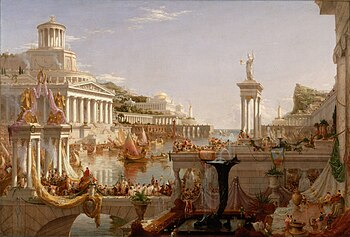
Consummation 

To illustrate the endurance of the natural world, Cole includes the same backdrop of a mountain rising into the sky in each painting.

The Iron Age 
The Iron Age is the result of a constantly consuming society. For the Greek oral poet, Hesiod, The Iron Age
is our own present day, wreaked by greed and ''the hurt of man''. This is Cole's 'Destruction'.

Destruction
Next, Cole believes, comes the final return of the natural world. Vines are shown growing over the ruins of a civilization. It's a quiet scene, slow and grand, the only ending and beginning.

Desolation


Tuesday, April 17, 2012

Project: Reading the Dictionary of Subjects and Symbols in Art


I’ve started a new project, which is reading The Dictionary of Subjects and Symbols in Art (one of many  books I bought from Hafa Books a few years ago that served to sit on my bookshelf until I rediscovered it) page by page. The dictionary narrates the themes and stories behind art-- allegories traced through historical, mythical and biblical figures and how they were perceived by artists through the centuries. The idea for reading the art dictionary in alphabetical order? 

It came from another book, Into the Forest by Jean Hegland. The novel is about two teenage sisters who survive in the woods when civilization comes to a halt after a series of global monetary and environmental collapses. In the book, the two characters try to continue practicing what they're passionate about during 'the lost time between the two halves of our real lives'. The younger sister, Nell, was planning on taking admissions tests to Harvard before the collapse and in attempt to continue her studies (computers are obviously no longer working) she reads and rereads every book she is stuck with in her house until resorting to reading the encyclopedia page for page:

"Fighter planes and supernovas and the falconlike divinity of the soul: death and flight, Heaven and the heavens. Even though it's only an alphabetical accident, there is a serendipitous rightness to that juxtaposition, and for a moment I wish my father were here so that I could prove him wrong."

The argument is the poetry of reading a reference book like this and beginning to notice the patterns and juxtaposition that connect every writer, philosopher and person in history. It's realizing the little things and the recurrences that drive through time.

The girls of Into the Forest were also unschooled before the collapse. Of her education and learning process Nell writes:

"For years I studied what I wanted to, when and how I wanted to study it. One book led to another in a random pattern, meandering from interest to interest like a good conversation, and the only thing that connected them was their juxtaposition on the bookshelves in Mother's workroom."

Jump back! (Side note: this saying is from Kevin Bacon's line in Footloose, which I've watched three times in the past two days, and I'm trying to bring it back as I think it sounds cooler than saying 'No way'! Join me in reviving it)

But, I wanted a way to expand my learning and give it more depth and meaning than just a few paragraphs of reading. And that's the idea for the blog posts. Every week of reading the art dictionary, I'm going to choose two subjects that interest me from my reading and research them before writing a blog post documenting what I've learned.


Saturday, March 3, 2012

unschooling and the whole wide world

Sandra Dodd says:
"There is a Sesame Street book called Grover and the Everything in the Whole Wide World Museum. There is a "things under the sea" room and "things in the sky" room, but still each room is just a room in a museum, no windows, everything out of context. Then he opens a big door marked "everything else in the whole wide world" and goes out into the sunshine. There is unschooling."

Sunday, February 26, 2012

When learning a language


I'm learning to speak French, which is rewarding, especially when Mademoiselle Jeannette (my teacher) is telling me a story in French and my mind is whirling with sounds and translating her words into English in my head. It's hard to describe learning a language. Sometimes it's romantic, tasting the cracks and ridges in the words and letting them color your brain. It's relearning everything you know, and involves so much of you on so many levels. It's brutal and systematic on paper, when you're dealing with grammar and verbs.

But it's different reading French aloud or speaking it--rerouting the primal knowledge of air in your lungs and patterns on your lips. It's an exercise in itself to make foreign noises and you learn to wrestle your mind in sync with the sprawling sounds.

Saturday, February 25, 2012

Unschooling philosophy


I recognize my unschooling philosophy in 
Gabriel Orozco's words:

"I like the idea of waking up in the morning and asking myself, What I want to do today? Do I want to ride my bike? Do I want to do nothing? Do I want to read? It’s raining. It’s not raining! If I keep myself open to these things, then I start to think about what is happening around me, and then I start to be more sensitive to whatever it is and I say, Oh yes, that is interesting! I try not to judge myself or analyze too much why I might be attracted to that one thing at a particular moment, as opposed to another. Instead I try to explore it and see what it is. I begin to play with it. The subject leads you to the medium, and then the medium is your way to resolve your relationship with that subject."


Friday, February 24, 2012

Studio Visit: visualizing my future


This post was inspired by the series ‘Studio Visits’, particularly Leanne Shapton’s entry, in The Paris Review. The series recruits various contributing artists and writers to describe their work spaces and work habits. I’ve used the articles as a prompt for visualizing my future, and this post is a pretty broad vision of my hopes, with no exact time period in mind:

I wake up facing the college, which is a sprawling eclectic paper romp. Pages ripped from magazines and fat art coffee table books, even photographs and sketches I've bought from street venders; gather here, hugging the bedroom wall I've taped them to. In this tunnel of faces and shapes, I can reach out and wrap color around my knuckles. One of my friends has christened the college after some mythos or beast from Hindu mythology (the name of which I can’t remember).


I rise and start the coffee and heat up last night's spicy chile, a very un-Parisian breakfast. You do get sick of croissants. I try not to be a cliche. 


Here is my living space, which is a flat that I transform frequently. I like to experiment with the way I capture ideas. First the idea isn’t even a concept really, just space and the white noise of my thoughts and then something vivid, that needs to be recorded, if only to help me understand it better. 


For the way I work with words, poems are rough sketches, the rawest and least understandable. I rarely use poems to capture feelings, if the idea is in that stage it’s pre-meaning. Poems are just arranging words, experimenting with the sting and sound of them. I repurpose poems when I can find meaning for them, in stories. 


Collages are helpful to me as well, working in images. Thus, my decor is the victim to the whim of my ever shifting inspiration.


I keep weird things from traveling too. Costume art, like skirts supported by wooden frames so they can stand on their own, haunt corners of my living space. The flat is just that--space, the perfect criteria. 


The floors are wooden, the only walls constructed are for the bedroom, down the narrow hallway, which also houses a bathroom in a nook. Upon entering the flat, you see the kitchen, which is barred off by a breakfast counter. 


Then the open area, which I’ve conquered with bookshelves (always the books) and long coffee tables (more books, framed artwork, lanterns, interesting items dealing with foreign religions and superstitions. the best furniture is haggled and battered, coming with a story). 


One of the tables is converted into a desk, housing my computer. 


Despite my flat, I live almost like a homeless person. Part of my stuff is always heaped in the corner and unpacked, because I am constantly traveling.


I angled my life this way, my goal was to be traveling. I knew I would be writing wherever I was, and picking up jobs that let me write. I am a perpetual motion idea collective, there is always new work, projects and conversation. I love it. 


I need this, to vibrant and creative, seeking that energy from art and music and people. I am in the streets continually, conversing or sketching outlines for poems. I need movement and words. 


My mainstays: Paris, where I work for independent newspapers and literature forms, and also where I can rely on a steady income. Guam, which will never stop being home. And Prague, where inspiration seizes and burns and everything else escapes me. Prague draws my best writing from me. I am a sucker for nostalgia and Prague, with it’s Gothic cathedrals, is my favorite lost world. 


And then there is the work. I'm in the middle of a short story for The Paris Review and I send off pieces of it to their editor monthly. I write in half hour periods. I take lots of breaks for walking or listening to music or stretching. 


Sometimes my projects are singular and I work independently. Other times  I work in a group and collaborate, which is fun for finding different formats. 


There is so much still to learn. I watch and wait. I create and collect. To quote Laini Taylor: Thank you to the world for being a wild and inspiring place, full of odd creatures, strange people, and mysterious cities. I hope by and by to know you better.