The heroes and gods in mythology and saints in religion with their love affairs, battles, heroes, sacrifices, honors and losses embody the human need for storytelling and the cultural recycling of the knowledge that grounds civilization. I'm realizing the connections as I'm writing this. My first entry that reflects on my reading is about The Ages of the World, a theme that runs through the writings of many poets and later appears in art.
The Ages of the World is a system that rehearses the world in harmony, and the changing seasons. It's basically an allegory that also represents the world trampled by humans, and the defining point that nature will take back the earth. Ovid, the poet behind the one first versions of The Ages of the World writes in The Metamorphosis:
O Time, thou great devourer, and thou, envious Age, together you destroy all things; and, slowly gnawing with your teeth, you finally consume all things in lingering death!
The Ages of the World explains the past, present and future in it's time periods.
The Golden Age
This is the Arcadia, the Garden of Eden. The dictionary says: "Man lived in a state of primal innocence, in harmony with his fellow men and with animals. He was without tools or means of cultivation and his simple needs were supplied by nature."
The Roman god of agriculture, Saturn, ruled. This also corresponds with the common idea that the Golden Age of the earth has already past.
And here's where we see how the arts inspire each other. During the Romanticism movement of the 1800s, American artist Thomas Cole painted series of cycles called 'The Course of Empire', which relates to The Ages of the World concept.The first painting, titled 'The Savage State', does not exactly resemble the idea of a golden age, instead showing a harsher first state of the earth.
 |
| The Savage State |
 |
| Pastoral State |
The Silver Age
In advertisements for the series, Cole draws from Romantic poet Byron, quoting this verse:
There is the moral of all human tales;
'Tis but the same rehearsal of the past.
First freedom and then Glory - when that fails,
Wealth, vice, corruption - barbarism at last.
And History, with all her volumes vast,
Hath but one page...
First freedom and then Glory - when that fails,
Wealth, vice, corruption - barbarism at last.
And History, with all her volumes vast,
The Silver Age begins organized society and the start of machines and shelter. Cole calls this period consummation.
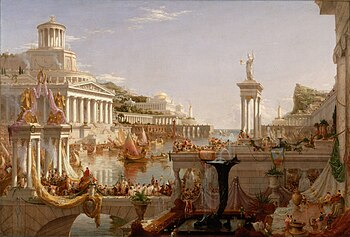 |
| Consummation |
To illustrate the endurance of the natural world, Cole includes the same backdrop of a mountain rising into the sky in each painting.
The Iron Age
The Iron Age is the result of a constantly consuming society. For the Greek oral poet, Hesiod, The Iron Age
is our own present day, wreaked by greed and ''the hurt of man''. This is Cole's 'Destruction'.
 |
| Destruction |
 |
| Desolation |

No comments:
Post a Comment